


Via Aswad Walker, Defender Network
Of all of Houston’s national accolades, including being the most diverse city in the nation, one area the Bayou City leads the country in could be the death of us. Literally.
No city in the nation pollutes its air and thus its residents like Houston.
Air Alliance Houston was founded in the late 1980s to reduce the public health impacts of air pollution and advance environmental justice through research, education, and advocacy. The organization, however, finds itself battling killer pollution-producing companies, regulators who turn a blind eye to cereal industry polluters, and lax state regulatory laws that allow for levels of “legal pollution,” levels that would be deemed criminal by countless other states, while rarely punishing companies for exceeding those “legal” pollution levels
Why does this matter? Residents of communities in the Houston area with the greatest levels of air pollution, all of which are predominantly Black and Latinx, have a life expectancy in some areas that’s 20 years less than areas with the least air pollution (all of which are predominantly white).
KILLER POLLUTION STATS
According to decades of data collected by the State of Global Air and the Institute for Health Metrics and Evaluation, they have been able to assess the proportion of certain diseases that can be attributed to air pollution. Here are the numbers:
· 40% Chronic Obstructive Pulmonary Disease (COPD/respiratory illness)
· 30% Lower Respiratory Infections
· 26% Stroke
· 20% Diabetes
· 20% Neonatal Deaths
· 20% Ischemic Heart Disease
· 19% Lung Cancer
In other words, air pollution accounts for 26% of the reason why individuals suffer strokes, 20% of the reason behind neonatal deaths, and a whopping 40% of the causal factors leading to COPD.
“If we were to have healthy air, if our standards for particulate matter, ozone and other kinds of carcinogens were within healthy limits as set by the World Health Organization, as set by the Environmental Protection Agency, we could, in theory, reduce these proportions of disease,” said Air Alliance Houston’s Executive Director, Jennifer Hadayia. “We could reduce potentially the incidents or the severity of these diseases because we know air pollution contributes to those proportions.”
Hadayia, however, wants Houstonians to know that the diseases listed above are not the only damage done by air pollution.
“It makes logical sense that breathing in air toxics would affect your respiratory system, your lungs because that’s the pathway into the body,” said Hadayia. “But research shows definitively that breathing in those toxins short- and long-term also affects your reproductive system, it affects your cardiovascular system, and a growing body of research shows that it also affects diseases of aging, Alzheimer’s and dementia.”
Don’t miss out! Get top Black headlines in Houston/Texas/America in your inbox Monday-Saturday.
Hadayia added that emerging research also shows that exposure to air pollution, short-term and long-term affects our behavior and can be a contributor to increases in crime.
“So, truly, air pollution contributes to every major health and social issue,” she said.
ETHNIC MEDIA HOUSTON TOXIC BUS TOUR
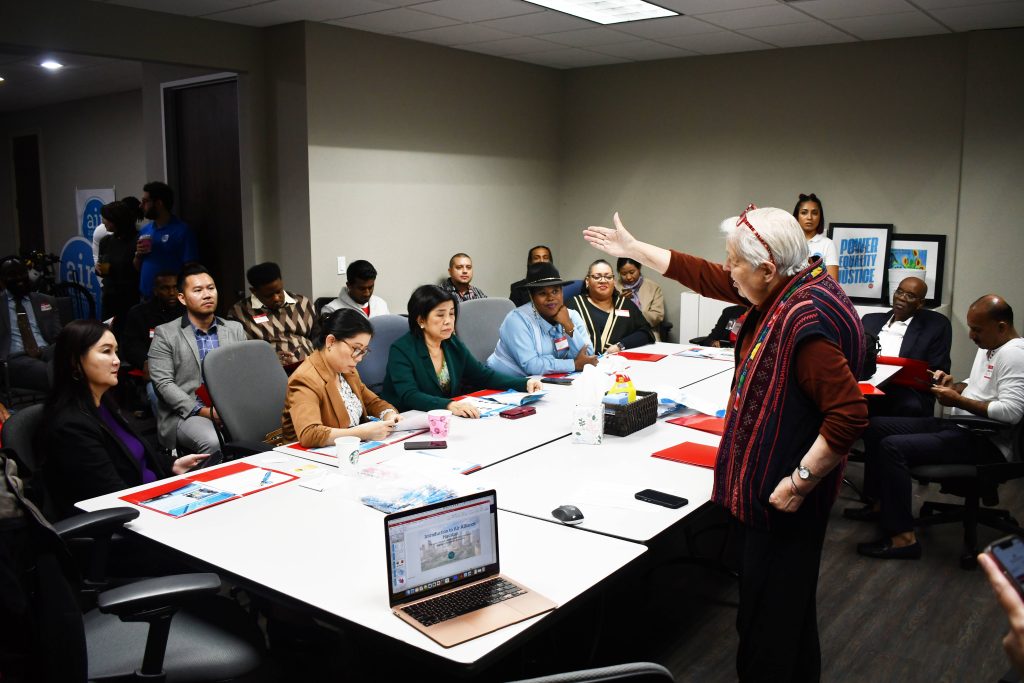
Seeking to raise awareness of this clear and present danger, Houston Ethnic Media in partnership with Air Alliance Houston sponsored an “Ethnic Media Toxic Bus Tour” of Houston.
Houston Ethnic Media is the local version of Ethnic Media Services out of California, founded by Sandy Close, which was founded to enhance the capacity of ethnic news outlets to inform and engage diverse audiences on broader public issues with the goal of building a more inclusive participatory democracy.
The tour was designed to visit three sites: The LBJ Hospital in Fifth Ward (Kashmere Gardens), Galena Park, and the Houston Ship Channel.



Kashmere Gardens is a community that’s 96% people of color (73% Black, 22% Hispanic, 1% other). Roughly 33% of the population speaks Spanish and 64% of this community is low income. Kashmere Gardens is home to six concrete batch plants. According to Rice University’s Kinder Institute, concrete batch plants produce “a kind of air pollution called particulate matter that can penetrate deep into the lungs,” and is “just one part of the problem that concrete batch plants present.”
Because the Texas Commission on Environmental Quality (TCEQ) grants them 24-hour permits, heavy diesel trucks line up as early as 2 a.m. to idle noisily on local streets, waiting to pick up as many as 150 loads every day, emitting even more pollutants like black carbon and nitrogen dioxide.